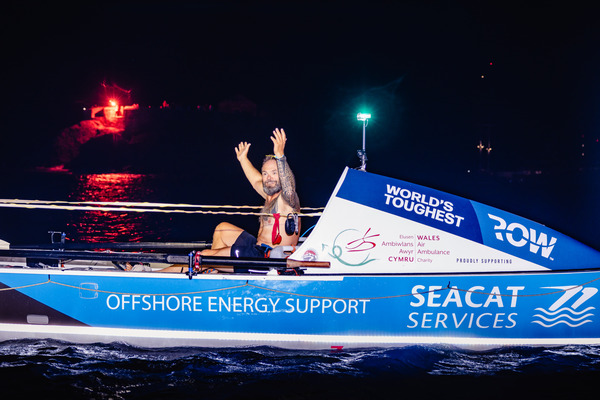
An adventurer who braved six weeks at sea taking on the World’s Toughest Row has raised £30k for Wales Air Ambulance. That is the equivalent of the cost of seven lifesaving helicopter missions.
48-year-old Ian Baylis, from Aberdyfi took on a solo 3,000-mile challenge setting off from San Sebastian de la Gomera, Canary Islands on 12th December 2025. He completed the trip which ended at English Harbour, Antigua in 42 days!
Ian who runs his own company alongside his wife Nia in the commercial maritime industry said: “It has been an incredible journey, and I could not have done it without the support of my amazing wife, family, sponsors, and supporters.
“I managed to cover the distance in what I understand was a solid time, compared to solo averages over the years!
“I knew I wanted to do this in aid of Wales Air Ambulance from the start. I hoped it would inspire people to want to donate because everybody around Aberdyfi knows somebody who has had a friend, neighbour or relative that has needed the service.”
Wales Air Ambulance is consultant-led, taking hospital-standard treatments to the patient and, if required, transferring them directly to the most appropriate hospital for their illness or injury.
It is delivered via a unique third sector and public sector partnership. The Wales Air Ambulance Charity relies on public donations to raise the £13 million required every year to keep the helicopters in the air and rapid response vehicles on the road.
The Emergency Medical Retrieval and Transfer Service (EMRTS) supplies highly skilled NHS consultants and critical care practitioners who work on board the Charity’s vehicles.
This advanced critical care includes the ability to administer anaesthesia, deliver blood transfusions and conduct minor operations, all at the scene of an incident.
As a pan-Wales service, its dedicated crews, regardless of where they are based, will travel the length and breadth of the country to deliver emergency critical care.
Ian’s connection with air ambulances also spans back to his childhood. His mum worked in the NHS, and her late twin sister oversaw the GHEMS air ambulance at the Royal London Hospital.
He said: “When you take on these challenges, it helps to have something driving you on and for me it was about giving back to something which had meant so much to my family members over the years.”
Ian has crossed the Atlantic several times and spent a lot of hours training before the race, so he thought he knew what to expect.
He said: “I had in my head before I set off, the things I thought were going to be most the difficult, but they turned out to be the least problematic.
“Night-time was a challenge, my cabin, had to be sealed up all the time, as it also acts as a life capsule, it had no ventilation – so felt like a sauna.
“My head was also a metre away from the hydraulic ram which drove the autopilot, so I found it hard to drop off to sleep. Music on loop was my escape.”
The ocean proved challenging too. He said: “At times, the sea state was ‘really odd,’ you would get sea coming from the side and behind at the same time, depending on which direction the wind was coming from.
“It was not like being on a river or rowing machine, you had to be a contortionist – trying to get your oars in. That was quite frustrating, having an oar in midair, then suddenly, it is coming back at you, hitting you on the shin or shoulder.”
Thankfully, Ian did not suffer any injuries during his journey. He puts this down to Nia’s expert advice, a fellow adventure enthusiast, who completed the race the year before.
He said: “I kept everything ship shape, by sticking to a fixed eating, drinking, sleeping, and hygiene plan.
“You have got to understand everything you do on dry land, is ten times harder when you are at sea, on a twenty-two-foot boat. But, if you cut corners, you end up with open wounds and sores, and the wheels start to fall off.”
Ian set himself many goals during his challenge, but the biggest one was to switch off completely and leaving what he calls ‘the bat phone’ at home with Nia. He also chose not to look at the race a tracker, to keep up to date with how fellow challengers were doing.
He said: “I had a completely clean phone; all I used it for was to send video footage back to Nia to use on social media. I was very much paddling my own canoe, in my own world oblivious to everything else that was going on.”
The hardest part of returning home, has been his ‘reintegration into a normal routine’ and finds it amusing when people ask, ‘What’s it like back in the real world?’
The dad of two said: “It gets very real out there, with nature, the weather, the ocean. You are in control of your own destiny; you are your own survivor. The ‘real world’ is a whole big planet, where you can have a whole load of adventures.”
He added: “The biggest thing I have learnt is that on a personal level I am all right. Having that amount of alone time, you think a lot about life. I have a great life with Nia and the kids; I am incredibly grateful for what we have created together.”
Ian aka ‘Lightship Atlantic’ will attend a special ceremony at the Mayfair Hotel, London alongside his fellow World Toughest Row challengers on the 17th of April, where he will receive a certificate in recognition of his achievement.
Elaine Orr, Wales Air Ambulance Regional Fundraising Manager said: “Ian is a true adventurer with a big heart! What he has achieved is quite breath-taking, it has taken courage and sacrifice, to take on such a mighty challenge.
“There are few people who can say that they have rowed the Atlantic in 42 days.
“We are so incredibly grateful that Ian chose to do the World’s Toughest Row in aid of Wales Air Ambulance, raising an extraordinary amount of money that will help save lives. Diolch yn fawr!”